J2 · University of Sharjah · 2026
How posture changes brain–muscle coupling during balance
Corticomuscular coherence in people with and without forward head posture, as balance gets harder.
- Status
- Manuscript under review
- Role
- Data analyst
- Signals
- EEG · EMG: tibialis anterior and gastrocnemius, both legs
- Methods
- Coherence · spectral power
Research question
Does spinal alignment change how strongly the brain and muscles couple when balance becomes difficult?
My role
I was the data analyst on the study, working with Dr. Ibrahim M. Moustafa, Dr. Alham Al-Sharman and Dr. Meeyoung Kim.
- Acquisition. EEG recorded on Nexus (Mind Media), with synchronised surface EMG from tibialis anterior and gastrocnemius on both legs.
- Preprocessing. Cleaning and segmenting both signals by balance condition.
- Coherence. Corticomuscular coherence between EEG and EMG, plus EEG spectral power by band.
- Statistics. Posture variables against neurophysiological outcomes, condition by condition.
Experiment
Main result
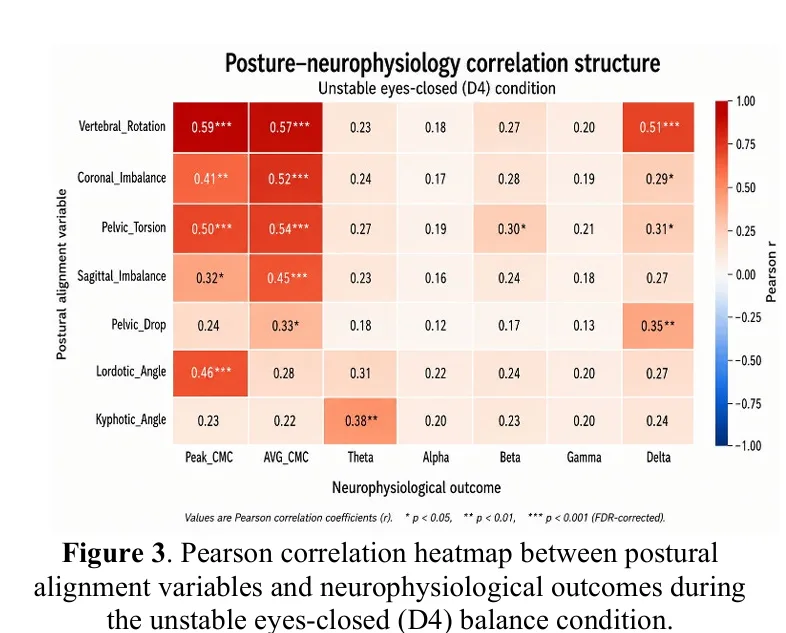
Across conditions
Interpretation
During the most challenging balance condition, corticomuscular coherence points to increased cortical engagement with postural malalignment: the brain appears to take a more hands-on role in balance when posture is off. These are associations from a cross-sectional design, so they describe how the measures move together rather than what causes what.
What I learned
Coherence is simple to compute and easy to over-read. Most of the work is upstream: getting two different signals cleanly aligned, choosing segments that mean the same thing across participants, and resisting the urge to report every band that crosses a threshold. The graded-difficulty design earned its keep, because a difference that grows with difficulty is far more convincing than a single contrast.